
Long County Court Records After Arrest
Court records after a Long County jail arrest are separate from the first booking entry. The roster can show the person, arrest date, statute, charge description, warrant number, total bond, and court field. That helps identify the case path, but it is not the formal docket. The Long County Sheriff's Office court guide says the sheriff cannot provide court dates, case status, or specific legal details. Those questions must go to the specific court, the District Attorney's Office, or the Public Defender's Office.
The arrest-to-court path usually starts with a Long County arrest or booking, then a roster charge, then a first appearance or warrant-related proceeding, then prosecutorial review. Felony matters are tied to Superior Court and the Atlantic Judicial Circuit District Attorney. Misdemeanor or state-court matters may follow a different track. Bond can be shown on the roster, but Long County's jail page states that bond amounts are set by Magistrate Court, State Court, or Superior Court, not by the sheriff.
Find Long County Court Records
No official free Long County criminal case-search portal was located in the research. The practical search begins with the roster, then moves to the clerk or court. The roster is useful because it gives names, dates, court labels, warrant numbers, and statute numbers that can help the clerk locate the public case record. For custody and booking detail, use the Long County jail inmate records path before calling the court.
- Search the Long County roster and write down the name, arrest date, statute, charge description, warrant number, and court field.
- If the court field or issue points to Magistrate Court, call Magistrate Court for warrant, preliminary hearing, or bail questions.
- If the charge is a felony or the field says Superior Court, contact the Long County Clerk of Superior Court.
- Ask the clerk which court manages misdemeanor, State Court, or Juvenile Court records when the roster field is unclear.
- Use the District Attorney's Office for prosecution routing, victim-services routing, or questions about filed felony charges when appropriate.
- Use the sheriff open-records email for arrest reports or incident records controlled by the sheriff.
The GSCCCA Long County clerk listing is a useful directory source for court records because it identifies the clerk, courts managed, hours, address, and phone. The GSCCCA Long County clerk listing screenshot below supports the clerk contact route for Long County court records after a jail arrest.
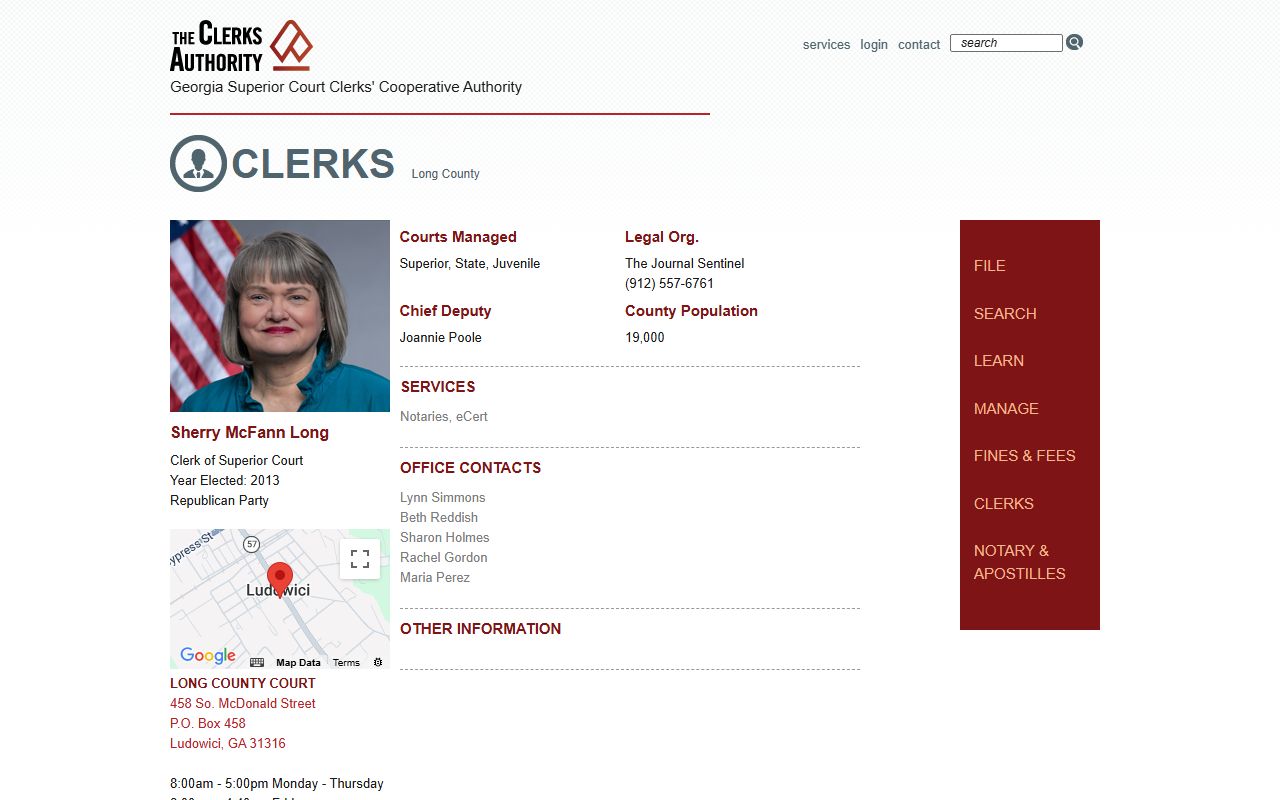
Use the clerk directory for court-record contact details, not as a jail roster. Booking status and physical custody remain separate from docket access.
Long County Court Access Channels
Different offices hold different records after a Long County jail arrest. The sheriff may have arrest or incident records. The clerk has court filings and docket information where public. The Magistrate Court handles warrants, preliminary hearings, and bail where allowed. The District Attorney handles felony prosecution in Superior Court for the Atlantic Judicial Circuit.
| Channel | How to Use It | What It Covers |
|---|---|---|
| Long County roster | Search current or arrest-date entries. | Booking charges, bond field, court label, warrant numbers, and housing county. |
| Clerk of Court | Call (912) 545-2123 or use the clerk address at 458 S. McDonald Street. | Public dockets, filings, court dates, and dispositions where available. |
| Magistrate Court | Call (912) 545-2315 for Magistrate matters. | Arrest warrants, search warrants, preliminary hearings, minor criminal matters, and bail where allowed. |
| Superior Court | Use the clerk and Long County Superior Court channel. | Felony cases, indictments, pleas, trials, and dispositions. |
| District Attorney | Contact the Atlantic Judicial Circuit District Attorney. | Felony prosecution decisions and victim-assistance routing. |
| Open records | Email foia.request@longcountyso.org for sheriff-controlled records. | Arrest reports or incident records, subject to redaction and exemptions. |
| GBI or GCIC | Use GBI or the sheriff's GCIC process when a criminal-history record is needed. | Statewide criminal history, often with consent and fee rules under Georgia law. |
Long County Charging Documents
After a jail arrest, the roster charge is not always the final court charge. Prosecutors review reports, warrants, evidence, and prior court orders before formal charges are filed or changed. Georgia felony cases may involve indictment by a grand jury, while other matters may use a prosecutor-filed accusation or information. The exact path depends on the court and offense.
| Document | Filed By | Common Use | Long County Context |
|---|---|---|---|
| Complaint or warrant document | Law enforcement or court process | Initial arrest or probable-cause basis | May be reflected by roster warrant numbers and Magistrate Court activity. |
| Accusation or information | Prosecutor | Formal charge without grand-jury indictment where allowed | Check the clerk and prosecutor for filed charges. |
| Indictment | Grand jury | Felony prosecution | Superior Court and the Atlantic Judicial Circuit DA are the key channels. |
Long County Charge Status
Charge status can change after a Long County jail arrest. A person can be booked on one description, then face an amended, reduced, added, dismissed, or indicted charge later. A release from jail is not the same as a dismissed case. A denied bond or hold may keep a person in custody before any final disposition.
| Status | What It Means | Where to Verify |
|---|---|---|
| Pending | The charge or case remains open and not finally disposed. | Clerk or court managing the case. |
| Amended | The filed charge was changed after review or court action. | Clerk docket and prosecutor channel. |
| Reduced | The charge was lowered to a lesser offense or different level. | Clerk records, plea documents, or prosecutor updates. |
| Dismissed | The charge was terminated by court or prosecutor action. | Official court disposition. |
| Nolle prosequi | The prosecutor declines to proceed on that charge. | Court filing or disposition entry. |
| Conviction | A final finding or plea of guilt, not the same as an arrest. | Clerk, GBI/GCIC, or court record. |
Charges and Convictions Compared
The distinction between a charge and a conviction is central to Long County court records after a jail arrest. A charge is an accusation or filed count. A conviction is a final court outcome after a plea, verdict, or other adjudication. Public records may show both, but they do not mean the same thing.
| Point | Charge | Conviction |
|---|---|---|
| Stage | Begins with arrest, warrant, accusation, information, or indictment. | Comes after plea, verdict, or qualifying court disposition. |
| Proof level | Based on probable cause or prosecutor filing decision. | Requires adjudication under the criminal case standard. |
| Roster relation | Often appears first in the Long County charge table. | Usually must be verified through court or criminal-history records. |
| Effect of release | Can remain pending after release from jail. | May affect sentence, probation, or state criminal history. |
When a statewide criminal-history record is needed, Long County's GCIC page says valid photo ID, identifying data, and consent where required may apply. It lists a $20 cash fee and says most requests are completed within three business days.
Long County Bond Authority
Bond is part of court records after arrest because it is a court decision even when the amount appears on the roster. Long County's sheriff page states that the office does not set bond. The appropriate judicial body sets it, including Magistrate Court, State Court, or Superior Court. The Magistrate Court page adds that magistrates may grant bail when bail-setting is not reserved to another court.
| Bond Situation | Meaning | Local Route |
|---|---|---|
| Cash bond | Eligible cash, money order, or cashier's check may be posted. | Confirm with Long County Sheriff's Office before payment. |
| Property bond | Property secures release when allowed. | Long County requires proper ID and proof of value, with a separate fee for in-county property bonds. |
| Bail bond | Approved bondsman posts bond for a nonrefundable fee. | Long County lists surrounding-county bonding companies. |
| Denied or not set | Bond is not currently available or has not been entered. | Call before travel because court action may be needed. |
| Hold | Another custody issue blocks release. | Long County holds must be processed through LCSO, not only the housing jail. |
Long County Arrest Warrants
Warrants often connect the booking record to the court record. The Long County roster includes a Warrant# column, and observed entries used formats such as W25-138, W25-139, W26-29, and 2020-R-018-GC. Magistrate Court handles arrest and search warrants and preliminary hearings. The sheriff staff page lists Mary Cooper as Warrants Clerk.
No standalone official public warrant search-field page was captured in the research. Treat the roster as the public place where warrant numbers may appear on inmate entries, then confirm active warrant questions with the sheriff or the court. A person with an active warrant may be arrested, so the records path should not be treated as legal advice or a promise that payment clears the matter.
Important: Court dates come from the Clerk of Court. The Long County sheriff says it is not responsible for court-date notification.
Sealed and Restricted Records
Georgia uses record restriction language in many criminal-record contexts. Long County's GCIC page cites O.C.G.A. 35-3-37 for inspection, correction, and restriction of criminal records. It says restricted records do not appear on general non-criminal-justice background checks. Court records, arrest reports, and criminal-history records may each follow different rules, so eligibility should be checked with the court, GCIC/GBI, or a lawyer.
| Point | Sealed or Restricted | Expunged or Removed |
|---|---|---|
| Public visibility | Access is limited or withheld from general public search when law allows. | Removal language depends on the record type and statute. |
| Government access | Law enforcement or courts may retain access in defined settings. | Some records may still exist for official purposes. |
| Long County route | Check clerk, court, GBI/GCIC, or sheriff record holder. | Do not rely on a roster disappearance as proof of removal. |
Booking photos follow additional Georgia rules. Photo access and commercial-site removal are covered with the roster-photo path on the Long County jail mugshots record page.
Long County Court Offices
Use the right office for the right record. The clerk is the main route for public court records and dates. Magistrate Court handles warrants and preliminary matters. The District Attorney handles felony prosecution in the Atlantic Judicial Circuit, which serves Bryan, Evans, Liberty, Long, McIntosh, and Tattnall Counties.
Long County Clerk of Superior Court
458 S. McDonald Street
P.O. Box 458
Ludowici, GA 31316
(912) 545-2123
Superior, State, and Juvenile court records; weekday hours vary by day.
Long County Magistrate Court
P.O. Box 426
447 S. McDonald Street
Ludowici, GA 31316
(912) 545-2315
Warrants, preliminary hearings, minor criminal matters, and bail where allowed.
Atlantic Judicial Circuit District Attorney
945 E.G. Miles Parkway
Hinesville, GA 31313
(912) 876-4151
Felony prosecution for Long County and other circuit counties.